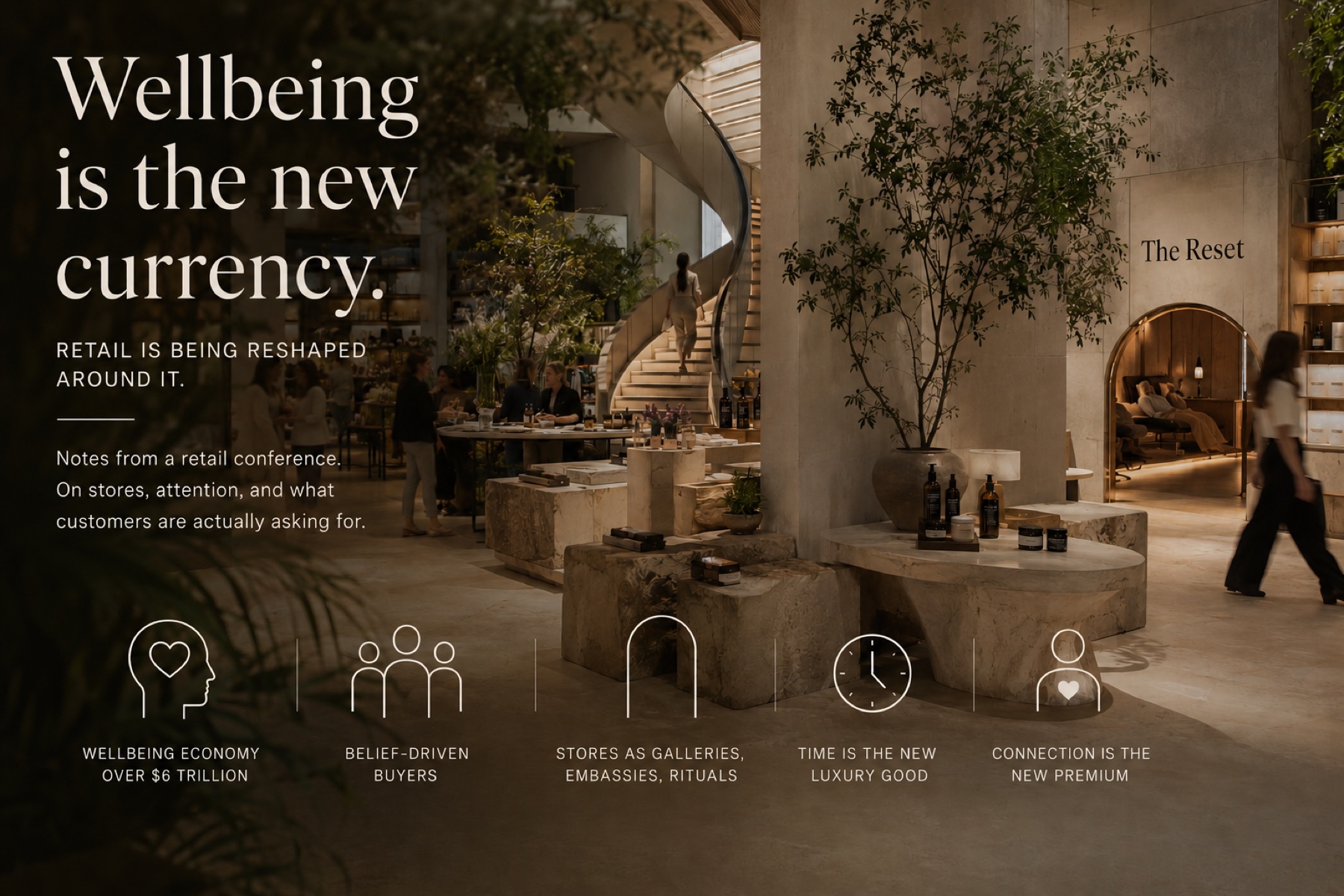
Speaking at a retail conference last week, the same questions kept surfacing. Where is retail actually going? What does a store even mean now? How do we navigate a customer who has changed so completely?
Attention is the scarcest resource on earth
The customer, on average, has almost none left. TikTok trained sub-second decisions. Phones get checked more than a hundred times a day. A widely cited Microsoft study clocked the average human attention span at eight seconds. Retail data quietly confirms it: shoppers spend an average of eight to fifteen seconds evaluating a product before their eyes move on.
Something is shifting. Not loudly, not all at once. But if you know where to look, retail is rewriting its own definition.
The wellbeing economy is now bigger than pharma
The Global Wellness Institute puts the global wellness economy at over $6 trillion, growing at roughly 8 to 10 percent a year. That is larger than the global pharmaceutical industry. Larger than automotive. And unlike them, it is defined less by product categories than by a state of being. How a customer wants to feel, live, become.
That number matters because it reframes what retail is selling. Products are still there. But what customers are paying for, increasingly, is the space between the products.
Belief is the new baseline
Edelman's Trust Barometer has been tracking it for years. Roughly two-thirds of global consumers now describe themselves as belief-driven buyers, choosing brands based on values, not just quality or price. Among Gen Z that number climbs higher still. And it makes sense. In an age of overload, where everything is available and almost nothing feels personal, the longing to connect only grows. To people, to places, to brands that actually stand for something.
For a retailer, this means the old script (beautiful product, tight merchandising, good service) is now table stakes. What earns a customer's loyalty in 2026 is what a store stands for. What it makes them feel. What it invites them into.
Standing for something used to set a brand apart. Today customers simply expect it. The question is no longer whether you have a purpose. It is whether people can feel it the moment they walk in.
The store as gallery, embassy, ritual
Walk into an Aesop flagship. There are almost no shelves. Products sit like objets d'art on stone plinths. The transaction happens quietly, sometimes later, sometimes online. The store's job is not to sell you soap. Its job is to hold a mood.
Walk into Erewhon in Los Angeles. It is technically a grocery store. It is also a place people spend two hours on a Saturday morning, because being seen there means something. Their celebrity smoothie collaborations with Hailey Bieber, Kendall Jenner and Bella Hadid routinely sell for around $20. That isn't grocery pricing. It's belonging pricing.
Ganni Studio in Copenhagen. House of Innovation in Shanghai. Corso Como in Milan. Walk into the House of Rituals in Amsterdam. It is technically the Rituals flagship, but calling it a store misses the point. Several floors of roaming experience: a restaurant, a body spa, workshops, retail, and at its heart the Mind Oasis, a multisensory pause experience rooted in neuroscience. A guided reset of thirty to sixty minutes that reframes wellbeing as something you experience, not something you master. Designed for the modern customer who is short on time but still wants the reset. And once the pause is done, they stay. Browse. Eat. Linger. The brand quietly stepped from selling products into hosting a wellbeing journey, one that people fly in to visit. Body, mind, soul, in one architecture. A 360° experience, not a point-of-sale.
Time is the new luxury good. Connection is the new premium
McKinsey's 2024 wellness research called this directly. Time and attention are the scarcest resources of the next decade, and consumers are willing to pay for the brands that give them both back.
That is why the Aesop store plays no music. Why Aman properties cap the number of check-ins per day. Why boutique wellness clinics offer ceremony around a treatment, not just deliver the treatment. It is why quiet luxury is not a trend but a response. To a decade of noise. To a phone that never stops. To a culture that has forgotten how to slow down.
But notice the deeper current underneath all of this. In a world where everything is tech, everything is instant, everything is algorithmically served, the biggest counter-trend is the human one. The return to real. We are queueing at sourdough bakeries and returning to the greengrocer who knows our name. Paying more for the handmade. Choosing the record shop over the algorithm. The word artisan is having its biggest cultural moment in a hundred years. Because when everything else feels fast and disembodied, what reads as luxury is what feels human.
So what does this mean for a retailer?
Four questions I keep asking, whether I am in a boardroom or shaping a concept myself.
1. What does your store hold?
Not what does it sell. What does it hold. Is it a mood. A ritual. A community. A perspective. The store as container of meaning is where the next decade of retail lives.
2. What can happen here that cannot happen anywhere else?
The physical space's job is no longer to move product. The internet does that faster and cheaper. Its job is to give the customer an experience the phone cannot. To let them truly connect to a brand. And once we connect, we stay.
3. Where does wellbeing show up in your architecture?
Wellbeing is not a category to add. It is a lens. Light, sound, scent, pace, materials, air. Every detail affects how a customer's nervous system responds. What is your store asking of a customer's body when they walk in.
4. What are you inviting the customer to become, not just buy?
This is the deepest question. The best emerging brands understand that a customer's identity is on the table. What version of themselves do they walk out as.
A framework, in one breath
Concept. Purpose. Presence.
Concept, what your store means. The idea that holds it together.
Purpose, what it is for, beyond the transaction.
Presence, how it makes the customer feel, second by second, from the doorway to the exit.
Get those three aligned, and the retail chapter that is opening will belong to you. Miss them, and your store will feel, however beautiful, like a museum for something that is already over.
A closing thought
The retailers that will define the next ten years are not the ones optimizing for conversion rates. They are the ones asking harder, slower questions.
What is our store for.
Who does it invite in.
What state does it hold.
The floor is moving. As a foresight strategist and concept developer, this is the shift I sit with daily, both for the brands I work with and for you reading this. My question back to you is simple. How are you going to navigate it?
What we shape now is more considered, more intentional, more human than anything the last decade rewarded.
I think that is a beautiful thing.